Short answer: count the hours of direct sun a spot gets in summer.
These are the extension-service definitions[1][2]. The catch is the season: in the California park below, 73% of the open ground is full sun in June and 0% in December. Check a spot in summer for summer crops and again in winter for anything that grows through it.
You can't watch next season's shadows today. The free BotaniSense app simulates them: enter your address and it shows the sun hours for any spot in your yard, for every month of the year.
What full sun, part sun and shade mean
- Full sun: 6 hours or more of direct sun. K-State's definition is specific: "direct summer sun for six or more hours per day"[2]. Most vegetables, roses and Mediterranean herbs want this.
- Part sun / part shade: about 3 to 6 hours. Minnesota Extension calls it light or part shade, "about 3 to 6 hours of sunlight"[1]; K-State puts light shade at three to five hours[2]. Leafy greens, many perennials and shrubs do well here.
- Shade: less than 3 hours[1]. Ferns, hostas and other woodland plants.
Bright light without direct sun, such as an open spot on the north side of a house, still counts as shade. Sources disagree by an hour here and there, so a spot right on a boundary can go either way.
Why the same spot changes with the season
Two things change. The day gets shorter in winter, and the sun gets lower, so everything casts a longer shadow. A bed that clears a fence in June can sit in the fence's shadow all day in December. How much depends on how far you are from the equator:
| City | Daylight | Noon shadow of a 3 m fence | ||
|---|---|---|---|---|
| 21 Jun | 21 Dec | 21 Jun | 21 Dec | |
| Singapore 1° N | 12.2 h | 12 h | 1.2 m | 1.4 m |
| Miami 26° N | 13.7 h | 10.5 h | 0.1 m | 3.5 m |
| Los Angeles 34° N | 14.4 h | 9.9 h | 0.6 m | 4.7 m |
| New York 41° N | 15.1 h | 9.3 h | 0.9 m | 6.2 m |
| Paris 49° N | 16.2 h | 8.2 h | 1.4 m | 9.4 m |
| London 52° N | 16.6 h | 7.8 h | 1.6 m | 11.2 m |
| Stockholm 59° N | 18.6 h | 6.1 h | 2.2 m | 23.6 m |
| Sydney 34° S | 9.9 h | 14.4 h | 4.7 m | 0.6 m |
Computed with SunCalc[3], the sun-position library the BotaniSense app uses. Noon is solar noon, when shadows are shortest; earlier and later they are longer still. Bars are capped at 12 m.
In Los Angeles a 3 m (10 ft) fence throws a 0.6 m shadow at noon in June and 4.7 m in December. In London it is 1.6 m and 11.2 m: in December the London sun climbs only 15° above the horizon, so even a low hedge shades a bed for most of a 7.8-hour day. South of the equator the seasons swap: Sydney's long, high-sun day is in December (14.4 h).
A park, simulated for a whole year
To see what this does on the ground, we ran a park in California through the BotaniSense app's sun simulation. It places the sun for every hour of the 15th of each month over a 3D model of the park, trees and houses included, and marks each patch of open ground as lit or in shadow. Each lit hourly sample counts as one hour of sun.
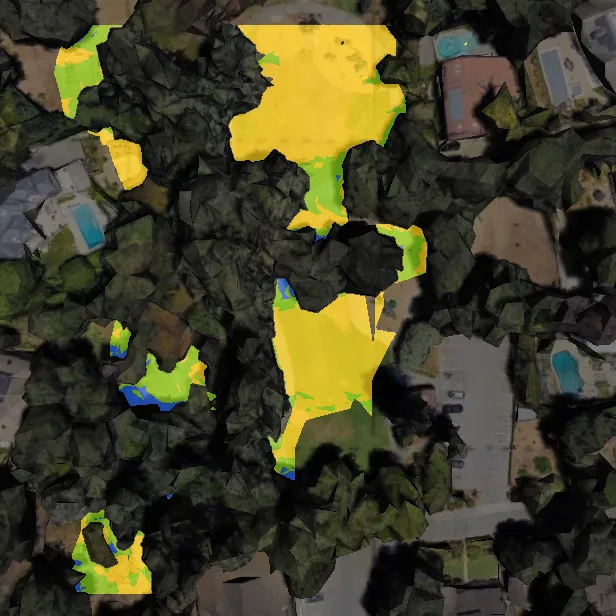
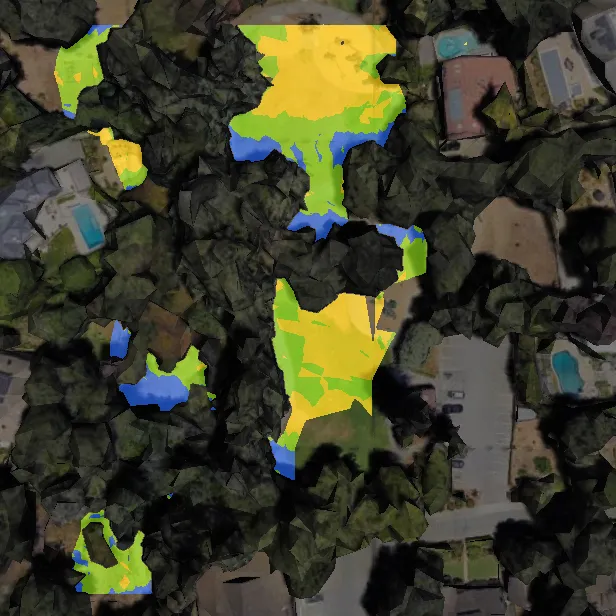
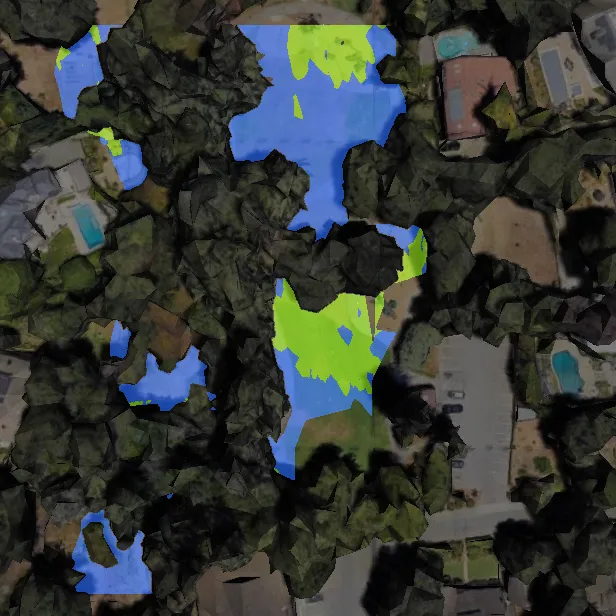
full sun (6+ h) part sun (3–6 h) shade (< 3 h) dimmed: tree canopy, roofs and paving, not measured
The open lawns are full sun from spring to late summer. By September the edges have turned part sun, and in December not one patch of ground gets 6 hours: 72% of it is shade.
The whole year at a glance
Share of the open ground in each category, the 15th of every month.
Four spots, four different gardens
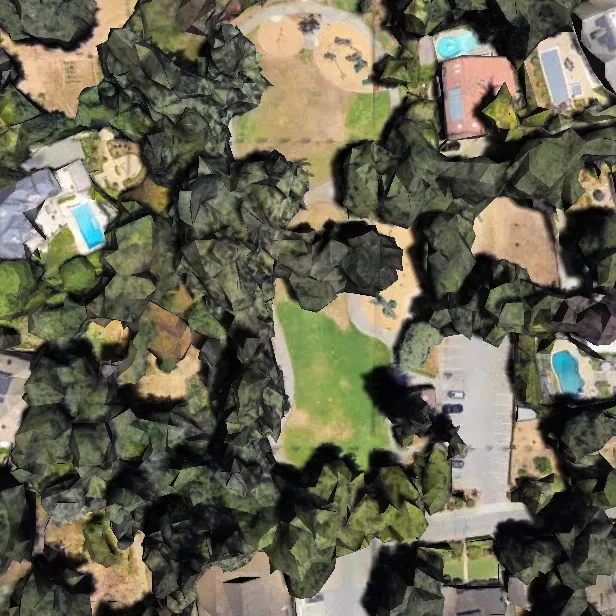
- 1 Open lawn: 8 h in June (full sun), 4 h in December (part sun / part shade).
- 2 Upper lawn: 8 h in June (full sun), 2 h in December (shade).
- 3 Lawn edge by tall trees: 4 h in June (part sun / part shade), 0 h in December (shade).
- 4 Small clearing: 5 h in June (part sun / part shade), 0 h in December (shade).
Sun hours on the 15th of each month; dashed lines at 3 and 6 hours.
The open lawn (1) and the upper lawn by the play area (2) both reach 8 hours in June, but in December the upper lawn drops to 2: the trees south of it shade it once the sun is low. The lawn edge (3) is part sun at best, and the small clearing (4) is a summer-only sun spot. Planting by the June number alone, you would put winter vegetables in spots 2 to 4 and they would sit in shade.
Morning sun or afternoon sun
Which hours matter too. Minnesota Extension: "morning sun is less intense and thus provides full sun conditions without extreme heat whereas afternoon sun is stronger and temperatures warmer"[1]. A part-shade plant that is happy with four hours of morning sun can scorch with four hours of afternoon sun.
| 6am | 9am | noon | 3pm | 6pm | ||||||||||||
|---|---|---|---|---|---|---|---|---|---|---|---|---|---|---|---|---|
| 1. Open lawn | ||||||||||||||||
| Jun | ||||||||||||||||
| Sep | ||||||||||||||||
| Dec | ||||||||||||||||
| 2. Upper lawn | ||||||||||||||||
| Jun | ||||||||||||||||
| Sep | ||||||||||||||||
| Dec | ||||||||||||||||
| 3. Lawn edge by tall trees | ||||||||||||||||
| Jun | ||||||||||||||||
| Sep | ||||||||||||||||
| Dec | ||||||||||||||||
| 4. Small clearing | ||||||||||||||||
| Jun | ||||||||||||||||
| Sep | ||||||||||||||||
| Dec | ||||||||||||||||
Yellow: the spot is in direct sun at that hour on the 15th of June, September and December (local clock time; June and September are daylight saving time).
The open lawn gets sun from about 8 am to 3 pm in June, then loses it to tall trees on its west side, so it has full sun without the hottest late-afternoon hours. In December its sun shrinks to 9 am–noon. The lawn edge gets only a midday window (11 am–2 pm in June), the hours when the sun is high enough to clear the trees.
How to measure your own garden
By watching
- Sketch the garden, beds and paths included.
- On a sunny day, look every hour from morning to evening and shade in what is in shadow. The RHS advice is the same: "make a note of where the sun is in the morning, afternoon and evening"[5]. A photo from the same window each hour works too.
- Add up the sunny hours for each bed and compare with the 6 and 3 hour lines.
- Do it again in winter, or near the end of the season, because shadows are much longer then (see the table above). If you can only do it once, do it at the time of year you are planting for.
Direction helps you guess before you measure: in the northern hemisphere, beds against a south-facing wall get the most sun, east-facing ones get the morning and west-facing ones the afternoon[5].
With a simulation
The maps on this page come from the Sun Simulation in the BotaniSense app. Enter your address, frame your yard in the 3D view and run the year; the app builds the surroundings from Google's Photorealistic 3D Tiles[4], places the sun with SunCalc[3] and tests every hour of the 15th of each month. Tap any spot for its sun hours by month. It answers the winter question in July, without waiting half a year.
What a simulation can't tell you
- Trees are always in leaf. The 3D model is captured once, so a deciduous tree shades as much in winter as in summer. In reality bare branches let in much more winter light, as the RHS notes[5], so winter shade under deciduous trees is overstated.
- Hourly steps. The sun is checked once an hour on the 15th of each month, so a spot's hours can be off by about one.
- Low sun barely counts. Just after sunrise and before sunset the sun is so low that it hardly brightens the ground, and the simulation may not count it as sun. Plants don't get much from it either.
- No weather. These are clear-sky hours. Fog, cloud and haze cut real sun, and a wall that reflects light can brighten a shady corner.
- Only open ground. Ground under a canopy cannot be seen from above, so it is left out rather than guessed. New fences, sheds and young trees appear only once the 3D map catches up.
FAQ
How many hours of sun is full sun?
6 or more hours of direct sun a day. Part sun or part shade is about 3 to 6 hours, and shade is less than 3. Plant labels mean summer sun: the same spot can get far less in winter.
Is morning sun or afternoon sun better for plants?
For plants that want part shade, morning sun is the safer half: it is cooler and less intense, while afternoon sun comes with the day's highest temperatures. Sun-loving vegetables and flowers simply want the hours, whenever they come.
Why does a sunny bed get so little sun in winter?
The sun is lower, so every fence, house and tree casts a longer shadow, and the day is shorter. At New York's latitude a 3 m (10 ft) fence casts a 0.9 m shadow at noon in June and a 6.2 m shadow in December.
Does shade from a deciduous tree count?
Only while the tree is in leaf. A bed under a deciduous tree can be in full sun in early spring and shade in summer, which suits spring bulbs and woodland plants.
Can I see the sun hours for my own garden without watching it all day?
Yes. The BotaniSense app's Sun Simulation takes your address, builds the 3D surroundings from Google's 3D map data and simulates the sun for every hour of a year, then shows the monthly sun hours for any spot you tap. The park maps on this page were made with it.
Who made this guide?
BotaniSense. We use AI and open data to bring plants closer to everyday life: what is growing around you, how to look after it, and where and when to go see it. Our main product is the free, ad-free BotaniSense app for iPhone and Android, which gathers the plant photos in your camera roll, identifies them, keeps a care diary and simulates sun and shade in your yard. About the BotaniSense app →
Sources
- [1] University of Minnesota Extension, reviewed 2026. Gardening in the shade
- [2] K-State Research and Extension, Johnson County, updated 30 Jun 2026. Defining Sun Requirements for Plants
- [3] GitHub (V. Agafonkin). SunCalc: a JavaScript library for calculating sun position and sunlight phases
- [4] Google Maps Platform documentation. Photorealistic 3D Tiles overview
- [5] Royal Horticultural Society. Get to know your garden